
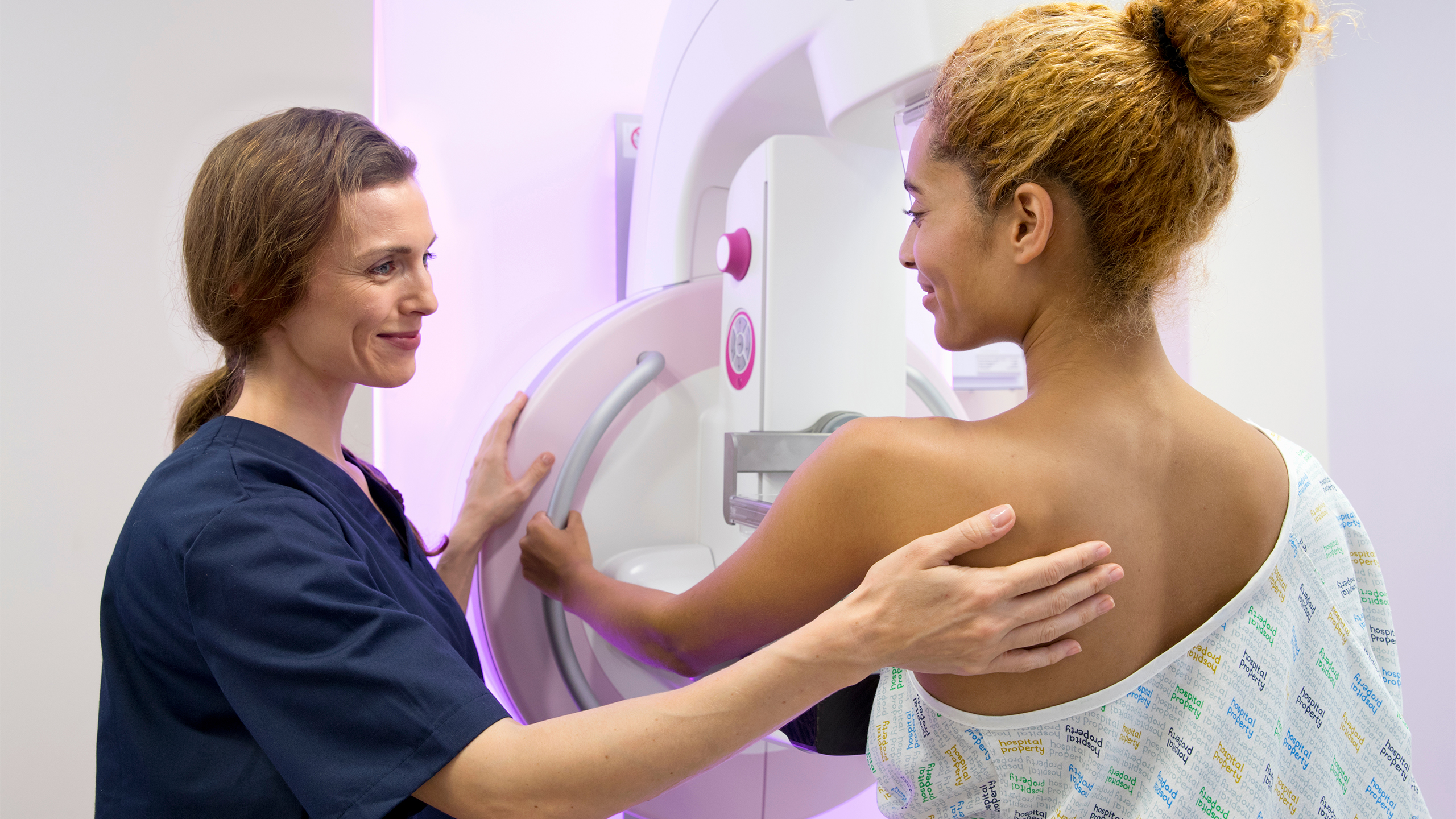
Mammograms save lives! Early detection plus starting treatment earlier equals a higher breast cancer survival rate. A mammogram is an X-ray picture of the breast. Doctors use a mammogram to look for early signs of breast cancer. They are considered the best way to detect breast cancer early.
There are two types of mammograms: screening and diagnostic. A screening mammogram is the basic mammogram all women need to get. But if you are experiencing breast changes, such as a lump, pain, nipple discharge, change in breast size or shape, or you’ve had breast cancer before, you’ll need a diagnostic mammogram. Also, if a screening mammogram shows an abnormality, your doctor may order additional imaging, like a diagnostic mammogram or breast ultrasound.
When Do Women Need to Start Getting Mammograms?
Most women should start getting an annual mammogram when they turn 40.
According to the National Breast Cancer Foundation, 1 in every 8 women will have breast cancer in her lifetime.
Breast cancer is the second most common type of cancer in women, second only to skin cancer.
Some women and men may need to start mammography screenings earlier than age 40. Your primary care provider (PCP), gynecologist, or oncologist may refer you for a mammogram earlier if you have these risk factors:
- If you have had breast cancer before.
- If you have a family history of breast cancer.
- If you or your doctor discover a lump in your breast or other questionable changes in breast tissue.
- If you test positive for BRCA and/or other genetic mutations that increase your likelihood of getting breast cancer.
- If you have dense breasts or certain benign (non-cancerous) breast conditions.
Mammograms Improve Breast Cancer Survival Rates
Along with monthly breast self-exams and yearly clinical breast exams (often part of a woman’s wellness visit or annual health exam), mammograms have helped save hundreds of thousands of women’s lives.
According to the American Cancer Society, when breast cancer is detected early and is in the localized stage, the five-year relative survival rate is 91% if the cancer is detected before it has started to spread.
%
Breastcancer.org reports that “Women diagnosed with breast cancer who had regular mammograms had a 60% lower risk of dying from the disease in the 10 years after diagnosis and a 47% lower risk of dying from the disease in the 20 years after diagnosis compared to women who didn’t have regular screenings.”
The improved survival rates from early detection make it clear that mammograms are the best weapon to defend yourself against breast cancer.
Even with advances in treatment, the American Cancer Society reports that more than 270,000 women were diagnosed with breast cancer, and more than 42,000 women in the United States died from breast cancer in 2023. However, there are more than 4 million breast cancer survivors in the U.S. today. This is why mammograms are so important!
While mammograms are the best way to detect breast cancer in the early stages, even before you or your doctor notices any changes in the breast tissue, it is also important for everyone to do regular breast self-exams and schedule their annual well-woman visit.
Breast Cancer in Hispanic Women
According to research by Dr. Amelie Ramirez from the University of Texas Health Science Center at San Antonio and a Komen scholar with Susan G. Komen, breast cancer is the leading cause of cancer death for Hispanic women in the U.S. This higher death rate for Hispanic women is related to a lower rate of Hispanic women getting screenings, including mammograms and clinical breast exams.
Ramirez reports, “Hispanic women are at risk for breast cancer. Their survivorship is not as good as other populations, and part of the reason for that is they’re not coming in for routine screening or not getting appropriate access to care, which causes some of the disparities within our population,” Amelie said.
Breast Cancer in Women Over 50
Per the CDC, “The risk for breast cancer increases with age. Most breast cancers are diagnosed after age 50.” This could be because many women in their 50s have had more years of menstruation, which means they have had more estrogen in their system.
What Happens During a Mammogram?
Mammograms are nothing to be afraid of! While they are mildly uncomfortable, most mammograms take only 15 minutes or less from start to finish. Here’s what to expect:
- A mammogram technician will ask you to undress from the waist up, removing your top and bra.
- You will change into a medical gown with openings in the front.
- The technician will help position you in front of the mammography machine and will physically move your torso, arm, and breast into the correct position for the X-rays (mammogram). They will place your breast between two plastic plates for scanning.
- The technician will tighten the two plastic plates onto your breast to flatten it out and get a good image of your breast tissue.
- The technician will tell you to hold your breath and stand very still.
- They will take some X-ray images of each breast, taking a few seconds for each photo.
- They will repeat this process with two or three positions for each side.
- The radiology clinic will send the images directly to your doctor for a screening mammogram. For a diagnostic mammogram, you may get results immediately.
- Your doctor will contact you in a few days or a week with the mammogram results.
How to Prepare for a Mammogram
Many women have feelings of anxiety, fear, or nervousness about getting their mammogram, but it is an easy, fast screening. Here are some tips to help you prepare and feel better about getting your mammogram:
- Schedule your mammogram for the week after your period, when your breasts are less likely to be tender.
- Wear a shirt and pants or a skirt, so you will only have to remove your shirt for the screening.
- Do NOT wear deodorant, powder, lotion, or perfume on the day of your mammogram, because these can show up as questionable areas and cause you to have to go back for a rescreening.
- Shower well on the morning of your mammogram to wash away any leftover deodorant, powder, lotion, or perfume from the day before.
- Reduce caffeine consumption a few days before and on the day of the mammogram. Caffeine can cause breast tenderness in some people.
What Happens If I Get a Call Back?
If your radiologist or doctor asks you to return for additional screenings, don’t panic! This is a very normal occurrence. Most women who get regular mammograms will experience at least one call back in their lives. This does NOT mean you have breast cancer.
If the radiologist cannot clearly see all of the details in the images from your mammogram, they may call you back as a precaution and to get more images. These are some common reasons you may get a call back on your mammogram, per VeryWell Health:
- Inconclusive results: calcifications, fibroids, dense breast tissue, asymmetry, or breast tissue pulling away from the nipple.
- First mammogram: more information may be required to establish a detailed baseline image for future comparison.
- Unclear X-rays: while the technician will try their best to make sure the images are clear, the doctor may want better pictures.
- Changes in the appearance of breast tissue when compared to previous imaging.
- Medical history: breast cancer survivors and breast cancer patients are more likely to be called back for further images, as their tests are being closely monitored for anything new or different.
When you get a callback, your doctor may request either a follow-up mammogram (diagnostic mammogram), breast ultrasound, or breast MRI. If there is any doubt about the presence of breast cancer, a biopsy may be needed. A biopsy is where a doctor removes a small amount of tissue in the breast to check for cancer.
Schedule your mammogram today and take control of your health!
If you are over 40, you can make an appointment for a screening mammogram at an imaging center in network with your health plan. You can also call your primary care provider or OBGYN if you have mammogram questions or if you’re not sure when or where to schedule. Community First Member Services can also help our health plan members find care. Call 1-800-434-2347 or the number on the back of your Member ID card to speak with someone who can help.
Sources
- Breast Cancer Awareness: Early Detection Can Save Lives. Community First Health Plans. Breast-Cancer-Awareness_Member-Tip-Sheet.pdf. 9/23/25.
- Mammograms. (n.d.). Johns Hopkins Medicine. https://www.hopkinsmedicine.org/health/treatment-tests-and-therapies/mammograms. 9/23/25
- (2023, July 31). The right age to get a mammogram? Your doctor can help you decide. Cleveland Clinic. https://health.clevelandclinic.org/when-should-you-start-getting-mammograms-your-doctor-can-help-you-decide. 9/22/25.
- DePolo, J. (2018, November 14). Regular Screening Reduces Risk of Dying From Breast Cancer. BreastCancer.org. https://www.breastcancer.org/research-news/regular-screening-reduces-risk-of-dying-from-bc. 9/20/25.
- Smith-Foley, S. (2020, April 28). Screening and early detection saves lives. CARTI. https://www.carti.com/health-insights/screening-and-early-detection-saves-lives. 9/23/25.
- Scardelli, L. (2024, October 25). 13 reasons for a mammogram callback. Verywell Health. https://www.vBreast cancer Statistics | How common is breast cancer? (n.d.). American Cancer Society. https://www.cancer.org/cancer/types/breast-cancer/about/how-common-is-breast-cancer.htmlerywellhealth.com/mammogram-call-back-6754744. 9/23/25.
- (2023, March). Breast Cancer Early Detection. National Breast Cancer Foundation. https://www.nationalbreastcancer.org/early-detection-of-breast-cancer. 9/22/25.
- Susan G. Komen®. (2025, March 17). Weighing the Benefits and Risks of Screening Mammography. https://www.komen.org/breast-cancer/screening/mammography/benefits-risks/. 9/22/25.
- (2023, September 1). What to know before your first mammogram. Hackensack Meridian Health. https://www.hackensackmeridianhealth.org/en/healthu/2023/09/01/what-to-know-before-your-first-mammogram. 9/23/25
- Breast Cancer Statistics | How common is breast cancer? (n.d.). American Cancer Society. https://www.cancer.org/cancer/types/breast-cancer/about/how-common-is-breast-cancer.html